Hakan Çelik
Run Methods Order In Python With More Explanation
Run Methods Order In Python With More Explanation
In the previous post we only printed the method name. This time each method logs its full set of arguments, which is ideal for following step by step what values Python passes and where. The inline comments show the actual output at each execution point.
class Meta(type):
    @classmethod
    def __prepare__(mcs, cls_name, bases, **kwargs):  # default, staticmethod
        prepare = super().__prepare__(cls_name, bases)
        print(f"Meta.__prepare__({mcs=}, {cls_name=}, {bases=}, {prepare=})")
        #       Meta.__prepare__(
        #           mcs=<class '__main__.Meta'>,
        #           cls_name='Example',
        #           bases=(<class '__main__.Base'>,),
        #           prepare={}
        #       )
        return prepare

    def __new__(mcs, cls_name, bases, namespace, **kwargs):
        new = super().__new__(mcs, cls_name, bases, namespace)
        print(f"Meta.__new__({mcs=}, {cls_name=}, {bases=}, {namespace=}, {kwargs=}, {new=})")
        #       Meta.__new__(
        #           mcs=<class '__main__.Meta'>,
        #           cls_name='Example',
        #           bases=(<class '__main__.Base'>,),
        #           namespace={'__module__': '__main__', '__qualname__': 'Example', '__new__': <function Example.__new__ at 0x109203c10>, '__init__': <function Example.__init__ at 0x109203ca0>},  # noqa
        #           kwargs={},
        #           new=<class '__main__.Example'> ( self )
        #       )
        return new

    def __init__(cls, cls_name, bases, namespace, **kwargs):
        init = super().__init__(cls_name, bases, namespace, **kwargs)
        print(f"Meta.__init__({cls=}, {cls_name=}, {bases=}, {namespace}, {kwargs=}, {init=})")
        #       Meta.__init__(
        #           cls=<class '__main__.Example'>,  ( self )
        #           cls_name='Example',
        #           bases=(<class '__main__.Base'>,),
        #           namespace={'__module__': '__main__', '__qualname__': 'Example', '__new__': <function Example.__new__ at 0x109203c10>, '__init__': <function Example.__init__ at 0x109203ca0>},  # noqa
        #           kwargs={},
        #           init=None  ( int return None )
        #       )

    def __call__(cls, *args, **kwargs):
        call = super().__call__(*args, **kwargs)
        print(f"Meta.__call__({cls=}, {args=}, {kwargs=}, {call=})")
        #       Meta.__call__(
        #           cls=<class '__main__.Example'>,
        #           args=(1, 2),
        #           kwargs={'c': 3},
        #           call=<__main__.Example object at 0x10d4c3940>
        #       )
        return call

class Base:
    pass

class Example(Base, metaclass=Meta):
    def __new__(cls, *args, **kwargs):
        new = super().__new__(cls)
        print(f"Example.__new__({cls=}, {args=}, {kwargs=}, {new=})")
        #       Example.__new__(
        #           cls=<class '__main__.Example'>,
        #           args=(1, 2)
        #           kwargs={'c': 3},
        #           new=<__main__.Example object at 0x109226a90>
        #       )
        return new

    def __init__(self, a, b, c):
        print(f"Example.__init__({self=}, {a=}, {b=}, {c=})")
        #       Example.__init__(
        #           self=<__main__.Example object at 0x10dd9e940>,
        #           a=1,
        #           b=2,
        #           c=3
        #       )
        self.a = a
        self.b = b
        self.c = c

    def __call__(self, *args, **kwargs):
        print(f"Example.__call__({self=}, {args=}, {kwargs=})")
        #       Example.__call__(
        #           self=<__main__.Example object at 0x10b2eea90>,
        #           args=(1,),
        #           kwargs={'k': 1}
        #       )

base = Example(1, 2, c=3)
base(1, k=1)
Things to Watch For
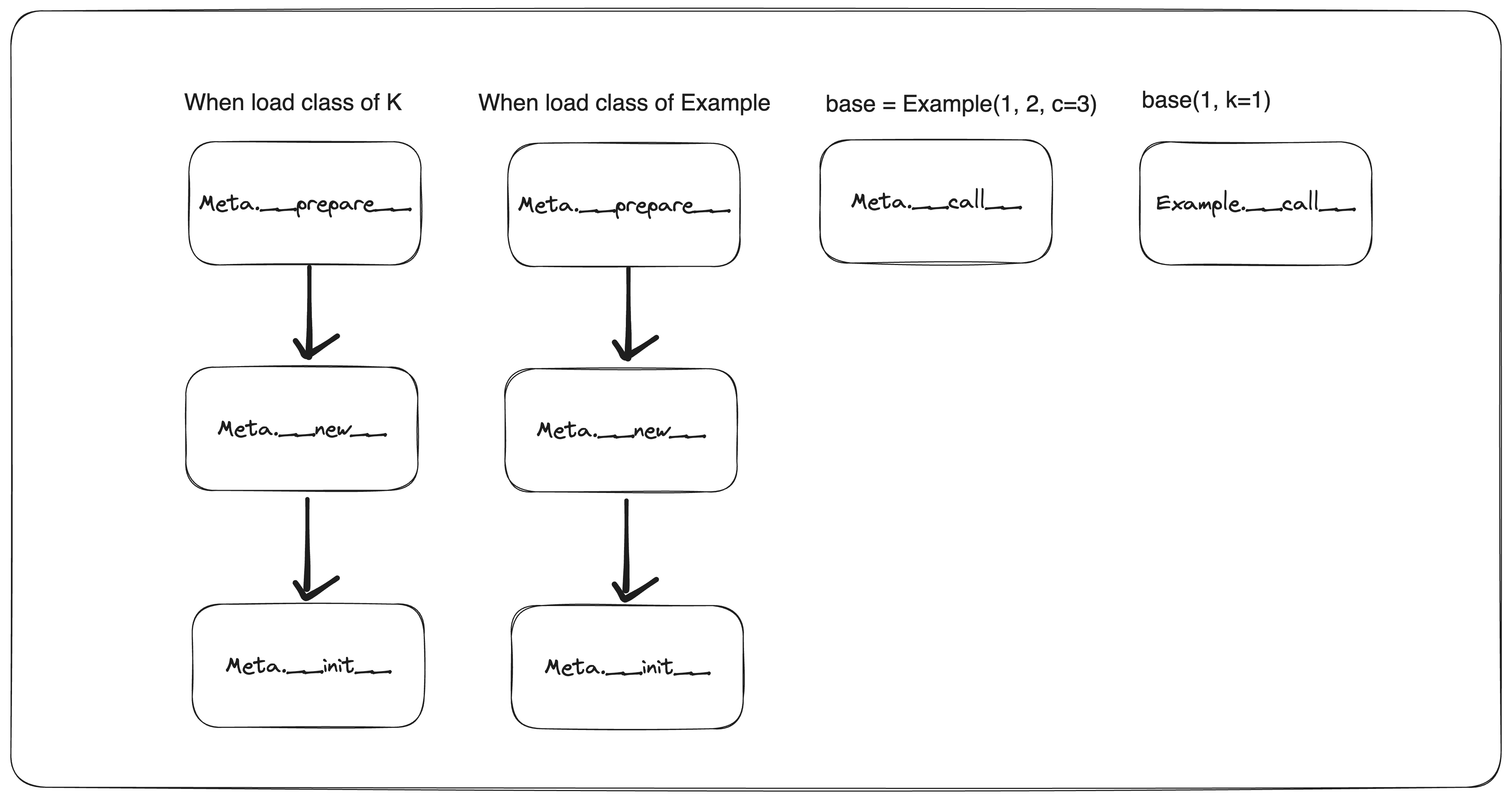
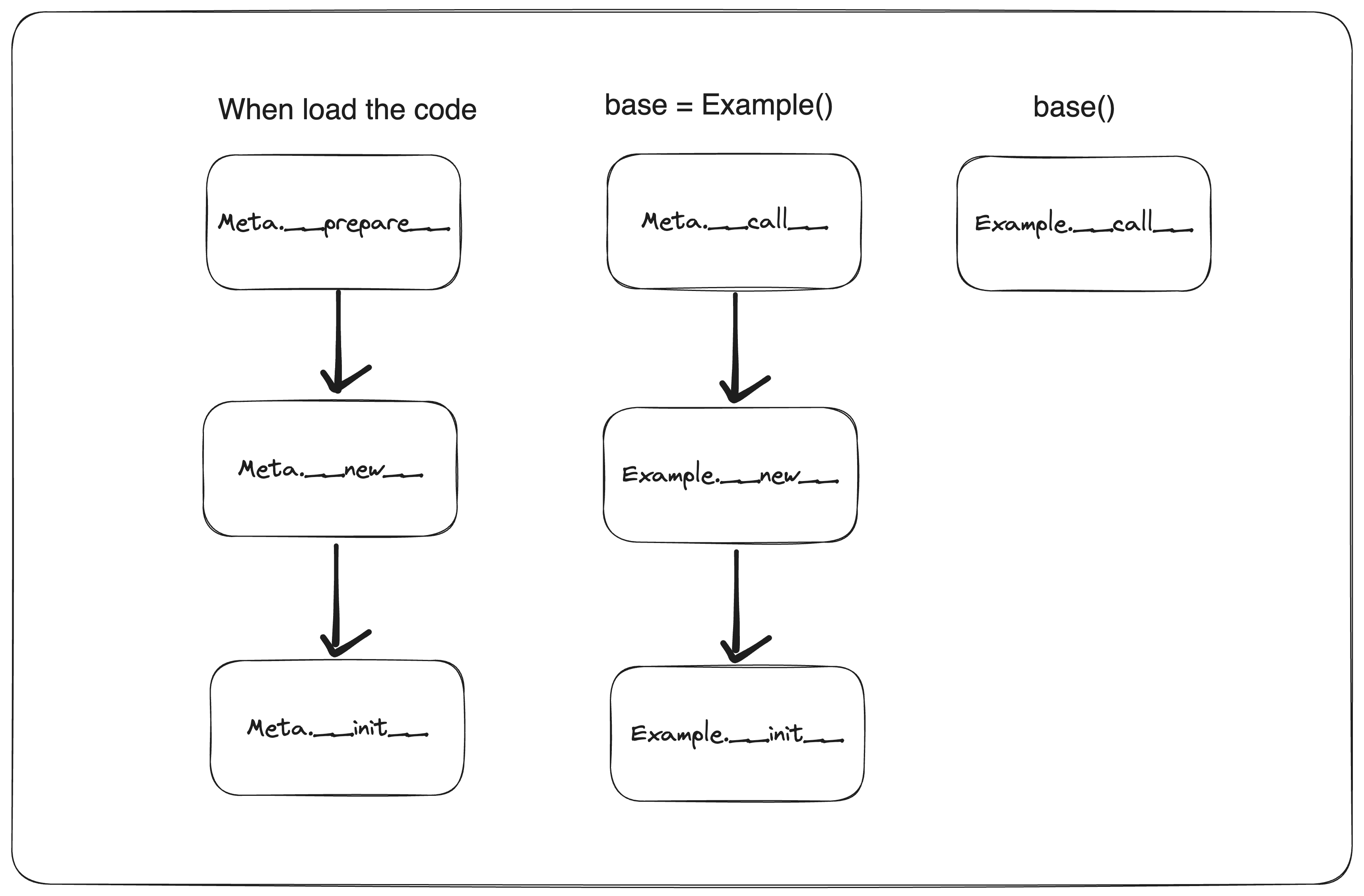
__new__ and __init__ arguments come from __call__. The chain Meta.__call__ → Example.__new__ → Example.__init__ is driven by super().__call__(*args, **kwargs). args=(1, 2) and kwargs={'c': 3} are forwarded identically to all three methods.
namespace is populated in __new__ but empty in __prepare__. When __prepare__ is called the body has not been executed yet; namespace returns {}. By the time it reaches __new__, namespace already contains all definitions such as __new__, __init__, and __qualname__.
The return value of __init__ is None. You can see init=None in the output; __init__ does not return anything — it modifies the class in place.