Hakan Çelik
· Hakan Çelik · OpenCV / Advanced Topics · 3 dk okuma
Contour Properties
Contour Properties
Here we will learn to extract some frequently used properties of objects like Solidity, Equivalent Diameter, Mask image, Mean Intensity etc.
NB: Centroid, Area, Perimeter etc also belong to this category, but we have seen it in last chapter.
1. Aspect Ratio
It is the ratio of width to height of bounding rect of the object:
Aspect Ratio = Width / Height
x, y, w, h = cv.boundingRect(cnt)
aspect_ratio = float(w) / h
2. Extent
Extent is the ratio of contour area to bounding rectangle area:
Extent = Object Area / Bounding Rectangle Area
area = cv.contourArea(cnt)
x, y, w, h = cv.boundingRect(cnt)
rect_area = w * h
extent = float(area) / rect_area
3. Solidity
Solidity is the ratio of contour area to its convex hull area:
Solidity = Contour Area / Convex Hull Area
area = cv.contourArea(cnt)
hull = cv.convexHull(cnt)
hull_area = cv.contourArea(hull)
solidity = float(area) / hull_area
4. Equivalent Diameter
Equivalent Diameter is the diameter of the circle whose area is same as the contour area:
Equivalent Diameter = √(4 × Contour Area / π)
area = cv.contourArea(cnt)
equi_diameter = np.sqrt(4 * area / np.pi)
5. Orientation
Orientation is the angle at which object is directed. Following method also gives the Major Axis and Minor Axis lengths:
(x, y), (MA, ma), angle = cv.fitEllipse(cnt)6. Mask and Pixel Points
In some cases, we may need all the points which comprises that object. It can be done as follows:
mask = np.zeros(imgray.shape, np.uint8)
cv.drawContours(mask, [cnt], 0, 255, -1)
pixelpoints = np.transpose(np.nonzero(mask))
# pixelpoints = cv.findNonZero(mask)
Here, two methods, one using Numpy functions, next one using OpenCV function (last commented line) are given to do the same. Results are also same, but with a slight difference. Numpy gives coordinates in (row, column) format, while OpenCV gives coordinates in (x,y) format. So basically row = y and column = x.
7. Maximum Value, Minimum Value and their locations
We can find these parameters using a mask image:
min_val, max_val, min_loc, max_loc = cv.minMaxLoc(imgray, mask=mask)8. Mean Color or Mean Intensity
Here, we can find the average color of an object. Or it can be average intensity of the object in grayscale mode. We again use the same mask to do it:
mean_val = cv.mean(im, mask=mask)9. Extreme Points
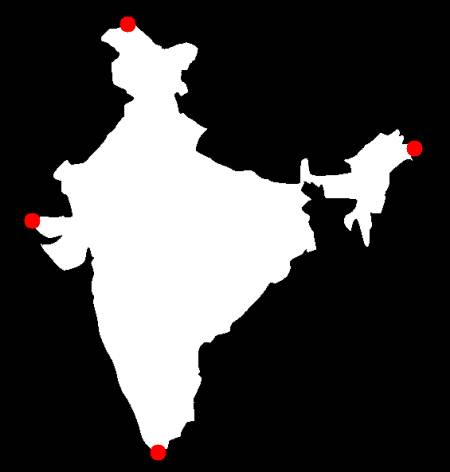
Extreme Points means topmost, bottommost, rightmost and leftmost points of the object:
leftmost = tuple(cnt[cnt[:, :, 0].argmin()][0])
rightmost = tuple(cnt[cnt[:, :, 0].argmax()][0])
topmost = tuple(cnt[cnt[:, :, 1].argmin()][0])
bottommost = tuple(cnt[cnt[:, :, 1].argmax()][0])
For eg, if I apply it to an Indian map, I get the following result:
Exercises
- There are still some features left in matlab regionprops doc. Try to implement them.